

As a scientist and a parent, I often feel like my primary function is to answer questions, sometimes with incomplete information. Mom, why is this booger red? (Don’t worry— it’s not a big deal. You probably just had a tiny cut in your nose!) Prof. Milkman, why did adding flattery to these emails make them less effective? (Maybe it made them feel insincere?) You get the idea, and you can probably relate.
But why do some explanations ring truer than others, even when they’re false? To offer one evidence-based answer to that puzzle, I’m sharing a Q&A this month with Princeton’s Tania Lombrozo — a psychology professor and author of the fascinating new book Why We Ask Why. In our conversation, she describes the kinds of explanations we find most compelling when we’re uncertain of the truth, and her theory about why they feel so right.
But first, here are some recommended listens, short reads, books, and an event I hope you’ll attend…
Recommended Listens and Short Reads
Why We Misjudge Social Connection: This recent episode of Choiceology featuring University of Chicago psychologist Nick Epley makes a science-backed case for having far more conversations with strangers.
What Brings Us Together: Harvard Professor Todd Rogers (featured in a previous edition of this newsletter) penned a terrific op-ed in the New York Times about the power of sports to unite Americans across political divides.
Legally Blonde (2001) with Katy Milkman: I had a blast discussing what the movie Legally Blonde gets right and wrong about stereotyping with hosts and fellow professors Eli Finkel and Paul Eastwick on the brilliant Love Factually podcast.
How a ‘Novelty Audit’ Could Simplify Your Life: I spoke with the New York Times about auditing the temptations you want to resist and creating “commitment devices” to help you dodge them.
Recommended Books
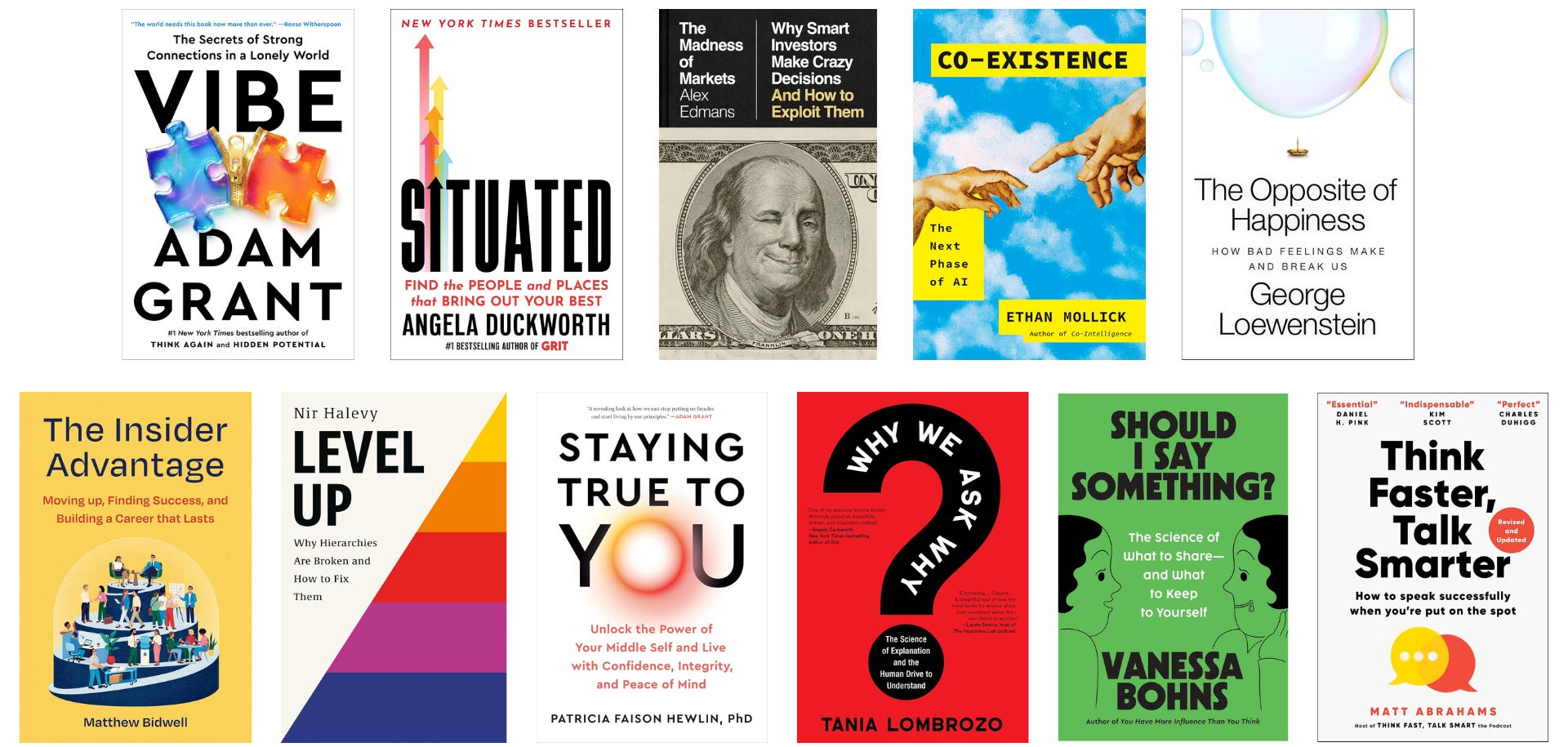
My friends have written 10 terrific new behavioral science books in the last two months! Here is a roundup (in alphabetical order):
Adam Grant: Vibe: The Secrets of Strong Connections in a Lonely World (listen to an interview with Adam on Choiceology here)
Angela Duckworth: Situated: Find the People and Places that Bring Out Your Best (listen to an interview with Angela on Choiceology here)
Alex Edmans: The Madness of Markets: Why Smart Investors Make Crazy Decisions (listen to an interview with Alex on Choiceology here)
Ethan Mollick: Co-Existence: The Next Phase of AI
George Loewenstein: The Opposite of Happiness: How Bad Feelings Make and Break Us (listen to an interview with George on Choiceology here)
Matthew Bidwell: The Insider Advantage: Moving Up, Finding Success, and Building a Career That Lasts
Nir Halevy: Level Up: Why Hierarchies are Broken and How to Fix Them
Tania Lombrozo: Why We Ask Why: The Science of Explanation and the Human Drive to Understand (listen to an interview with Tania on Choiceology here)
Vanessa Bohns: Should I Say Something?: The Science of What to Share—And What to Keep to Yourself
Plus, a revised and updated edition of Matt Abrams’ Think Faster, Talk Smarter just dropped.
Join Me & Angela Duckworth Online on 11/2 at 1:30 pm ET for a 30 Minute Book Q&A

Q&A: The Explanations that Ring True
This month’s Q&A from Choiceology is with Tania Lombrozo, a psychology professor at Princeton University and the author of the new book WHY WE ASK WHY. It’s a conversation about the explanations that ring true, even when they aren’t, and what many have in common.
Me: I’m excited to talk about your research on the kinds of explanations people prefer. First, can you describe the philosophical principle called Occam’s Razor?
Tania: I think we’re all familiar with some version of Occam’s Razor. On The Simpsons, Lisa explains that when there are multiple explanations, a simple explanation is probably the true one.
Me: Would you describe how you’ve tested whether people act like they believe in Occam’s Razor and whether their reasoning is sound?
Tania: It turns out that figuring out what counts as simple isn’t really simple at all. One of the ways we’ve tried to characterize this in psychological research is by thinking specifically about the case where you observe some things in the world and try to come up with a causal explanation. For example, you see that someone has symptoms and try to figure out what’s causing those symptoms. In that context, a simple explanation might be one that involves fewer causes that you just have to assume hold true.
Me: So, for instance, say I have blurry vision and an upset stomach. The complex explanation might be that I haven’t gotten enough sleep, and I have a stomach bug. A simpler one would be a disease that causes both blurry vision and upset stomach.
Tania: That’s right — it’s simpler because it’s one cause that accounts for both symptoms. In the lab, we give people scenarios just like the one you came up with, but also scenarios where they have some additional evidence about what’s most likely to be true. That way, we can explore whether people show a preference for simpler explanations not just when they have no additional information, but also when they do have some probabilistic information that might allow them to figure out what’s most likely. Most of the research suggests people still show a preference for the simpler explanation, perhaps more than they ought to.
Me: Can you describe your favorite study showing that people prefer simple explanations to complex ones, even when that’s not necessarily right?
Tania: Sure, my then-PhD student M Pacer and I collaborated on an experiment where we introduced participants to an alien planet and asked them to imagine that they were anthropologists learning, among other things, about various diseases these aliens suffer from. They got training about the possible disease, what symptoms they cause, and how common each disease was, and so on. Then they were told about a particular alien and their symptoms, like having purple spots and sore mintels (an alien body part we made up for the study). When participants diagnosed the aliens, we found that they preferred the simpler explanation when it was more likely, but also when it was less likely. It wasn’t until the complex explanation was many, many times more likely to be true that most participants would select that explanation.
Me: That’s fascinating. So am I oversimplifying, or is it fair to say: The fewer causes needed to explain a state of the world, the more we buy the story?
Tania: Well, there’s some nuance to how people show this effect. What people seem to care about isn’t just the number of causes per se, but the number of causes that are unexplained.
So, for example, suppose you had a student who is both hungry and tired. One way you might explain this is by saying that they’re hungry because they skipped breakfast, and they’re tired because they stayed up late. Those are two separate causes. But now I’m going to give you a common cause that explains both why they skipped breakfast and stayed up late, and that’s because they went to a party.
So now I’ve given you a third, more complicated cause, but I’ve also reduced all the causes to one underlying root cause. We talk about this as “root simplicity.”
Me: Why do you think we care about root simplicity?
Tania: I’m speculating, but I think it’s because when we’re trying to explain the world, we’re looking for useful levers if we want to be able to predict what’s going to happen or control a set of effects. Root causes allow you to efficiently represent what you need to know in your environment to make a bunch of predictions or where to intervene if you want to control some effects.
Me: That’s fascinating. Thanks so much for taking the time to answer my questions!
This interview has been edited for clarity and length.
To learn more about Tania’s insights on the explanations we proffer and accept, listen to the episode of Choiceology where we dig deeper into this topic, and be sure to pick up a copy of Tania’s new book WHY WE ASK WHY wherever books are sold.
Oh, and a little happy news to close: Choiceology is a gold medalist in the 2026 Signal Awards!
Wishing you a wonderful end of October. See you in November!
Katy Milkman, PhD
Professor at Wharton, Host of Choiceology, an original podcast from Charles Schwab, and International Bestselling Author of How to Change
P.S. Join my community of over 100,000 followers on social media, where I share ideas, research, and more: LinkedIn / X / Instagram / BlueSky / Threads
The part about root simplicity is the one I'd keep thinking about. If a single root cause is what makes an explanation feel right, then the explanations that feel best are the ones that hand you a lever, and that is a different property from being true. It also explains why 'one thing is behind all of it' stories are so sticky: they give you the biggest lever for the fewest assumptions. The party example works because the root cause there happens to be real. In a messier case, the pull toward a single root could make us stop looking before we have checked that it is there.
Katy Milkman, one might say that how we think, how we make choices, and how easily & readily we're persuaded depends greatly on how we're SITUATED!